Comfort
People who find traditional in-ear earbuds uncomfortable
The clearest reason to choose the XC1 is comfort. Instead of pushing a silicone tip into the ear canal, the earbuds clip around the outer ear and leave the canal open.

Audio & Calls / Product review
A clip-on open-ear option for people who want comfortable all-day listening, natural calls, and better awareness of what is happening around them.
01 / Quick answer
Baseus Inspire XC1 makes the most sense for people who like the idea of earbuds but dislike having their ear canals sealed for hours at a time. Its clip-on open-ear design keeps you aware of coworkers, traffic, and conversations around you, while still covering the basics most people expect from everyday wireless earbuds: music, calls, multipoint connectivity, and long battery life.
Call quality is one of the stronger parts of the package. Independent reviews from WIRED and Digital Trends both found the XC1 easy to use for everyday calls, especially indoors. Outdoors, the microphones can reduce some wind and traffic noise, but voices may sound more processed as the system works harder.
The biggest trade-off is also the reason to buy them: they do not isolate you from the outside world. In a quiet office or on a walk, that can feel freeing. On a subway, airplane, or loud café, outside noise can simply overpower what you are listening to.
02 / Fit
Comfort
The clearest reason to choose the XC1 is comfort. Instead of pushing a silicone tip into the ear canal, the earbuds clip around the outer ear and leave the canal open.
Awareness
You can listen to music or join a call without completely shutting out the person sitting next to you.
Daily routine
The XC1 fits users who move between a desk, a walk, light exercise, and errands throughout the day.
The clearest reason to choose the XC1 is comfort. Instead of pushing a silicone tip into the ear canal, the earbuds clip around the outer ear and leave the canal open. WIRED reported that the XC1 stayed comfortable even after hours of continuous use, and the clip shape can also be easier to live with than larger ear-hook designs if you wear glasses.
That does not mean every ear will love the fit. Clip-style earbuds depend heavily on ear shape, and comfort is always personal. But if your main complaint about regular earbuds is pressure, heat, or the plugged-up feeling that comes with a seal, the XC1 is aimed directly at that problem.
Open-ear earbuds are particularly useful in shared workspaces because they do not force you to choose between audio and awareness. You can listen to music or join a call without completely shutting out the person sitting next to you.
This is also useful during calls. Because your ears remain open, your own voice sounds more natural than it does with sealed earbuds. You do not need a transparency mode just to hear yourself speak normally.
The XC1 also fits users who move between a desk, a walk, light exercise, and errands throughout the day. Baseus gives the earbuds an IP66 dust- and water-resistance rating, and both WIRED and Digital Trends found the fit secure enough for active use.
This is not a product built around shutting the world out. It is built around staying connected to audio while remaining connected to your surroundings.

03 / Product focus
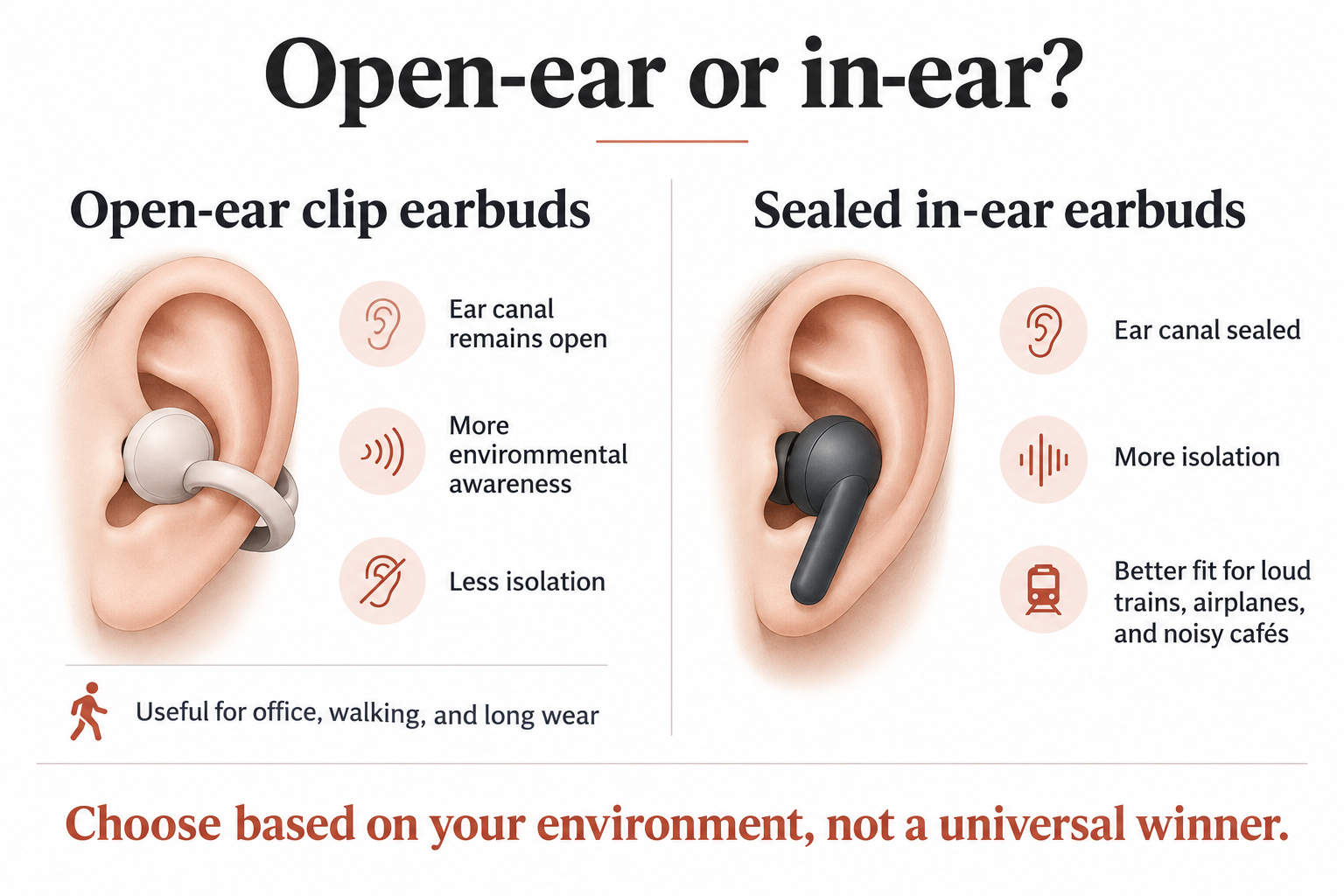
Traditional in-ear earbuds create a seal. That seal is useful when you want stronger bass, better passive isolation, and effective ANC. The XC1 deliberately gives up that seal.
The benefit is awareness and a less intrusive fit. The cost is that external sound remains part of the listening experience.
That distinction matters more than any individual feature on the spec sheet. If you want quiet on a plane, the XC1 is the wrong tool. If you want to hear coworkers, traffic, or your own voice naturally during a call, the open design becomes the advantage.
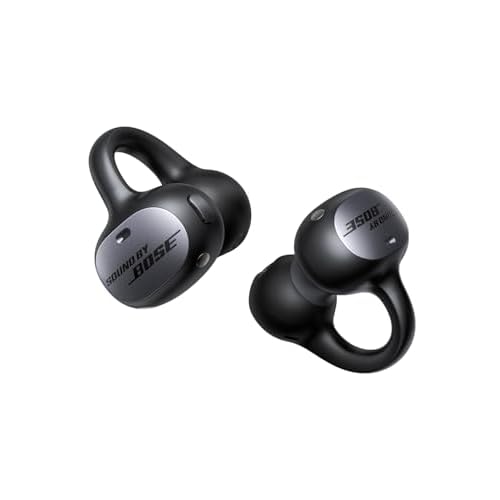
Baseus does more than rely on the open-ear form factor. The XC1 uses what the company calls a Hybrid 2-Way Driver System, pairing a dynamic driver for lower frequencies with a Knowles balanced-armature driver for the upper range. The product also carries Sound by Bose tuning, supports LDAC on compatible Android devices, and includes EQ controls in the Baseus app.
Those features matter because sound quality is often the weak point of open-ear earbuds. WIRED found the XC1 unusually competitive for the category, with strong bass extension and good clarity when the environment was quiet. Digital Trends also praised the bass and warm presentation, although it found the default tuning less energetic than some listeners may prefer.
The important qualifier is when the environment was quiet. Open-ear sound quality changes dramatically with ambient noise because there is no seal to protect the music from the outside world.
04 / Call performance
For everyday calls, yes - with an important distinction between quiet and noisy environments.
Digital Trends found indoor call quality excellent, with voices sounding clear on both ends of the conversation. WIRED also reported that callers could understand speech easily indoors and outdoors, with most background sounds kept under control.
Baseus advertises a four-microphone AI call system. The independent reviews matter more than the microphone count: they suggest the call system works well enough for ordinary office calls, phone conversations, and hybrid-work use.
Another benefit comes from the open design itself. Because your ear canal is not blocked, you hear your own voice naturally. For long conversations, that can feel less artificial than speaking through sealed earbuds.
Outside, the picture is more nuanced. Digital Trends found the microphones capable of reducing wind and traffic noise, but noted that voices could take on a slightly digital or processed character when the AI system had to work harder. WIRED similarly found calls easy to understand but noted some distortion outdoors.
That means the XC1 is well suited to normal walking calls and casual outdoor use, but it should not be treated like a dedicated boom-mic headset built for hostile noise.
This is the most important limitation to understand.
Even if the microphone system does a decent job helping the other person hear you, the XC1 cannot stop subway noise, a loud café, or heavy traffic from reaching your ears. Digital Trends found spoken content especially vulnerable in loud environments, while WIRED noted that outside sound could overpower calls and podcasts.
05 / Sound quality
Open-ear earbuds face a basic acoustic problem: they have to move sound across open air instead of sealing it into the ear canal.
The XC1 handles that compromise better than many budget open-ear designs. WIRED found its bass response particularly strong for the category and said its overall clarity competed with more expensive clip-style models. Digital Trends also praised the low end and warm presentation.
The Sound by Bose preset is warm and smooth rather than aggressively bright. Digital Trends found it pleasant for vocals and layered music but less exciting for high-energy tracks. WIRED also preferred a custom EQ with more low- and high-frequency emphasis.
That is not necessarily a flaw. It means the stock sound has a specific character. If you prefer a livelier or more neutral signature, the app's EQ controls are worth using.
On compatible Android devices, XC1 supports LDAC for higher-bitrate Bluetooth audio. But both WIRED and Digital Trends found the implementation less compelling than the feature list suggests.
Using LDAC disables Bluetooth Multipoint and the Bose EQ preset. Digital Trends also reported unstable high-bitrate connections and significantly shorter battery life with LDAC enabled. WIRED likewise found the highest-quality LDAC connection wobbly.
For most buyers, Multipoint and stable everyday use are likely more valuable than chasing the highest codec setting.
06 / Everyday use
Comfort
WIRED found the earbuds comfortable even after three hours of continuous wear, while Digital Trends described them as light enough for extended daily use.
Controls
XC1 uses physical buttons for playback, volume, calls, and voice assistant controls.
Workflow
Bluetooth Multipoint lets the earbuds stay connected to two devices at once.
Comfort is where the XC1 earns its place most clearly.
WIRED found the earbuds comfortable even after three hours of continuous wear, while Digital Trends described them as light enough for extended daily use. The clip format also avoids taking up as much space behind the ear as a traditional ear-hook model, which can make it easier to combine with glasses.
Instead of relying only on touch surfaces, XC1 uses physical buttons. That sounds minor until you are walking, wearing gloves, or trying to adjust playback without accidentally triggering the wrong command.
The Baseus app lets you customize click actions for playback, volume, calls, and voice assistant controls.
Bluetooth Multipoint lets the earbuds stay connected to two devices at once. WIRED and Digital Trends both highlighted the implementation positively, making the XC1 particularly useful for people who move between a laptop and phone during the day.
The main caveat is again LDAC: enabling it removes Multipoint.
Baseus rates the earbuds for up to eight hours per charge and up to 40 hours with the case under its stated test conditions. WIRED noted that these figures assume moderate volume and no LDAC or Dolby Audio use. Digital Trends found that LDAC could cut per-charge battery life significantly.
For ordinary use without the most demanding audio modes, the battery setup is competitive for a clip-style open-ear product.
07 / Trade-offs
XC1 does not offer active noise cancellation. More importantly, its open design also provides almost no meaningful passive isolation.
Traffic, gym equipment, café chatter, and public transportation remain audible. When the environment becomes loud enough, music loses detail and spoken content becomes harder to follow.
LDAC sounds attractive on a spec sheet, but on the XC1 it disables features many users may value more, including Multipoint and the Bose EQ preset.
The default tuning is smooth and bass-friendly. If you prefer crisp treble or a more analytical presentation, expect to spend some time with the EQ.
Many reviewers found the XC1 comfortable and secure, but ear shape varies. Open-ear does not automatically mean every clip design will fit every person equally well.
That is not a missing feature so much as the core trade-off of the category. If isolation is your priority, choose sealed in-ear earbuds instead.
Turning up the volume can compensate only so much, and it is not a substitute for isolation.
LDAC sounds attractive on a spec sheet, but on the XC1 it disables features many users may value more, including Multipoint and the Bose EQ preset. Independent reviews also found stability and battery trade-offs.
For most users, leaving LDAC off may produce a better overall experience.
08 / Decision
The XC1 is easiest to recommend to someone who already knows why they want open-ear earbuds.
If your goal is to block out the world, this product makes little sense. If your goal is to keep your ears open while still getting useful sound quality, reliable everyday calls, and a comfortable fit, the XC1 becomes much more compelling.
That is the key to evaluating it fairly: do not compare it with sealed earbuds as if both designs are solving the same problem.
Check current priceAffiliate link · Disclosure
09 / FAQ
Yes, especially for everyday indoor calls and relatively calm environments. WIRED and Digital Trends both found call performance strong enough for regular use. Outdoor wind and traffic can introduce more processing or distortion, and very loud environments can make it harder for you to hear the other person because the earbuds do not isolate your ears.
No. The XC1 uses an open-ear design that intentionally leaves the ear canal uncovered. That improves awareness but means there is no meaningful isolation from surrounding sound.
Independent reviews were positive about comfort. WIRED reported comfortable use over several hours, and the clip design avoids pressure inside the ear canal. Fit still depends on individual ear shape.
Yes. The earbuds support Bluetooth Multipoint for two-device connections. Note that enabling LDAC disables Multipoint.
It depends on your priorities. LDAC can provide higher-bitrate audio on compatible Android devices, but it disables Multipoint and the Bose EQ preset, and independent testing found battery and connection-stability trade-offs. For many users, the standard connection may be the more practical choice.
They are usually not the best fit for those environments. Because the design is open and has no ANC, loud background noise can compete directly with music, podcasts, and calls. A sealed in-ear model is generally better when isolation matters.
11 / Evidence and sources
This review is based on manufacturer documentation and independent professional testing. Nolmira has not personally tested the XC1.